Conservation of Cream Cheese Theorem

CreamCheeseOnCracker

“I want a knife. Can you give me a knife?”, Timon asked.

“Why do you want a knife?” I responded.

“I want to spread my cream cheese. On my cracker.”

“Why do you want to spread your cream cheese?”

“Because I want more cream cheese,” replied Timon.

I gave Timon a knife and he proceeded to take the cream cheese that was on his cracker and spread it out until it covered much more of his cracker. Then he smiled and ate the cracker.

Timon doesn’t yet know that no matter how he manipulates his cream cheese, there’s always going to be the same amount. He has yet to learn the Conservation of Cream Cheese Theorem.

But he from his actions we can infer what he does understand that the more area of cream cheese there is on his cracker, the more cream cheese there is. This is true, provided the thickness of the cream cheese is constant.

I wonder how much longer he’ll think that he can get more of something by spreading it out.

We have four people in our family

“We have two people.”

Timon, who is 3 years old, holds up 2 fingers on the same hand.

“What if Mommy comes back? Then we have three people. See? Three people.”
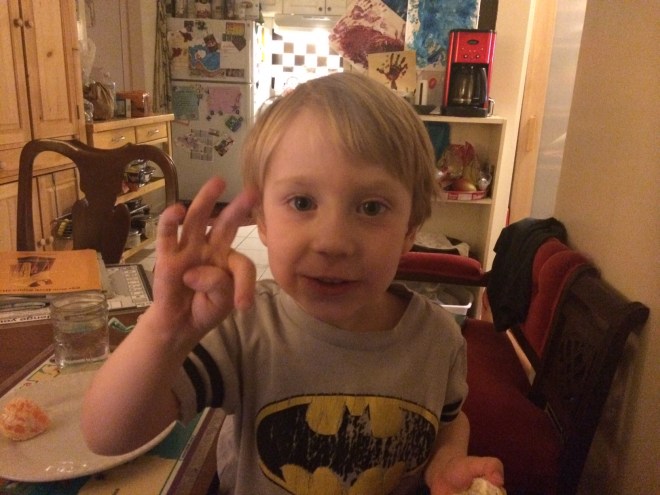
photo 2

Timon holds up 3 fingers on the same hand and then says, “And if Thanasis comes too? Then we have four people. Four people.”

photo 1

Timon holds up four fingers on one hand for emphasis. Then he giggles and holds up two fingers on one hand and two fingers on the other hand and says “See four people?”

I ask, “And what if Grandpa comes? How many people then?”

Timon says quickly, without any obvious counting with his fingers, “Five!” and then holds up all five fingers on one hand. Here, I notice him counting on rather than counting from one.

photo 3

“What if Grandma comes too?”, I ask.

Timon, without speaking runs up and shows me five fingers on one hand and one finger on his other hand and then says, “Six people.”

And then he’s done with this game and moves on.

Later I ask him again how many people are in our family and he holds up five fingers, looks at them and says, “I need to take one away. Four people” and folds his thumb up next to his hand.


This is the use of three different representations of numbers from 1 through 6, specifically the oral naming of the numbers, the use of his fingers to show the numbers, and then actual number of people being represented, and Timon is moving between the three representations fluently.

But he’s also only doing this for the first six numbers and I know that he doesn’t know the symbols for these six numbers yet. I’m also not sure yet that in every instance of these numbers appearing around him that he’s as fluent as when he is counting people. And as I recall with my older son, he was fluent with counting people before he was able to count other things.

I especially noticed this interaction because this is the first time I have seen him move between number representations greater than 4 things so effortlessly.


Noticing number strategies

Recently I ran a math class for a few younger students, including my son. The objective of this class were to start making connections between how students visualize numbers and early arithmetic strategies.

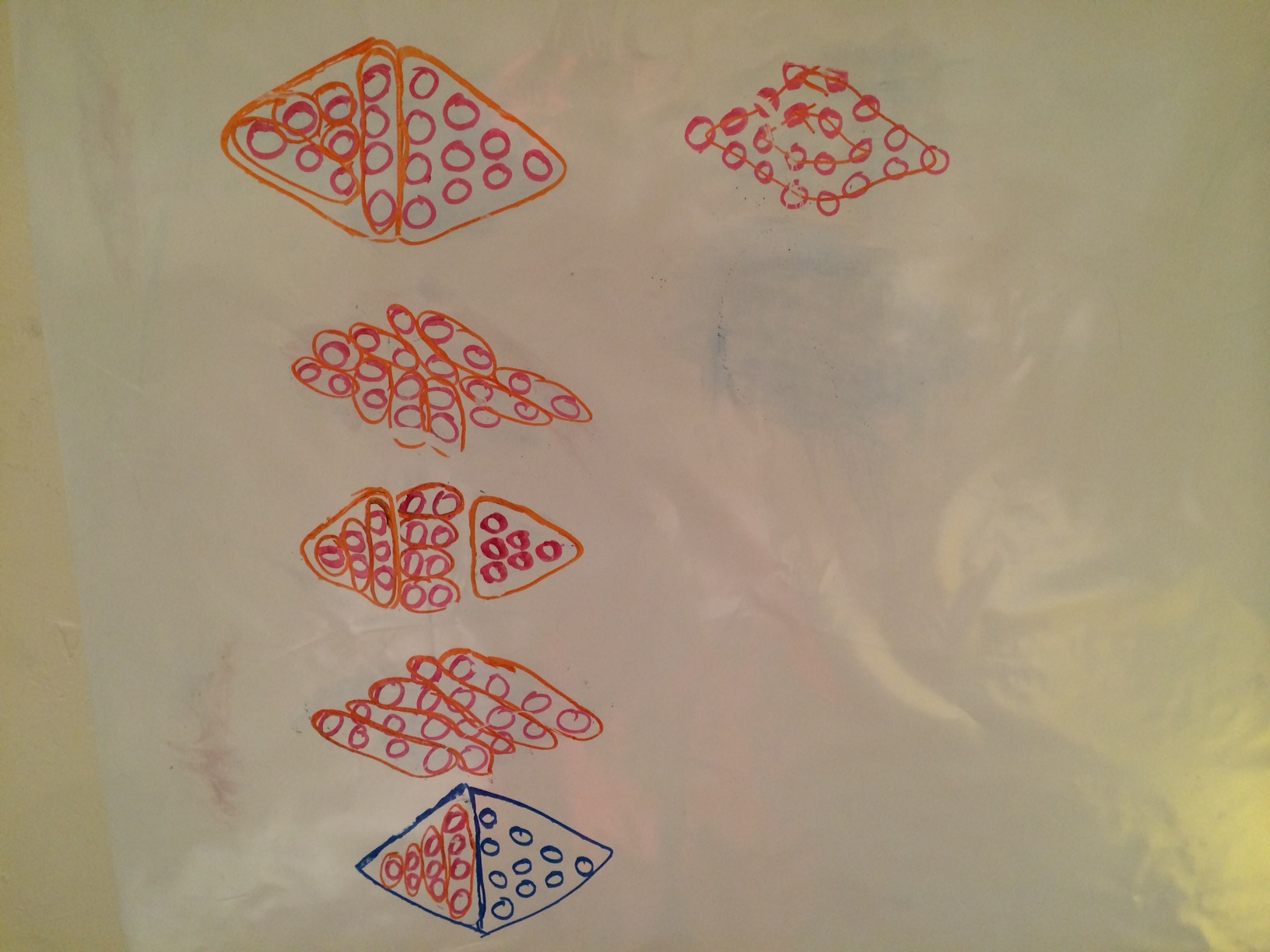
Here are some of the various ways students visualized a group of dots to figure out how many total dots there were.
Dot Pattern visualizations

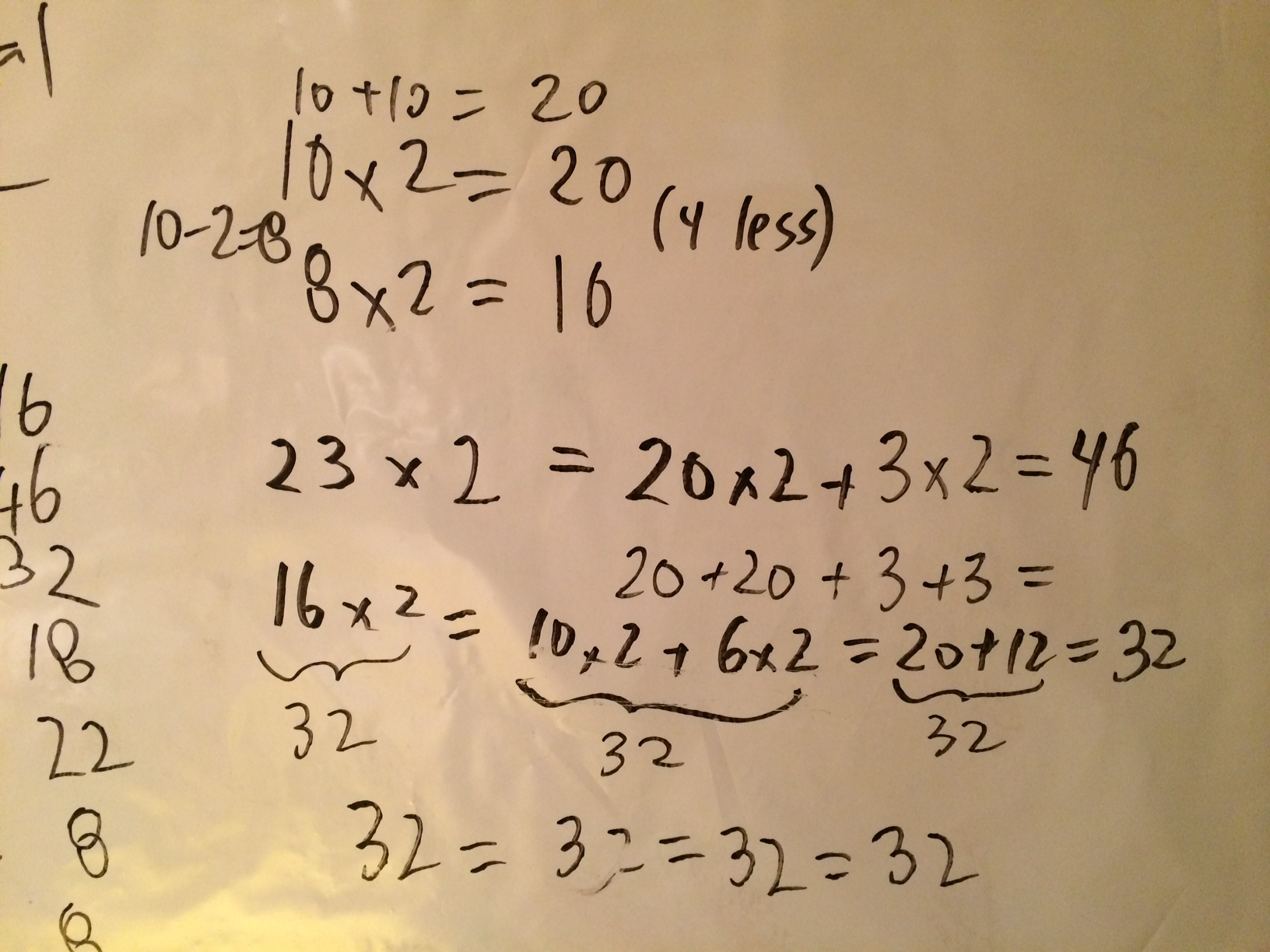
Here are some of the strategies students used when they doubled numbers in their pattern.
Double strategies

I asked students to look at the visualizations for the dot patterns and the arithmetic patterns and see if they noticed anything in common between the dot visualizations and the doubling strategies. They didn’t.

So I told them to find a partner, talk to their partner about the same questions, and then told them we would discuss it again. Two minutes later, I asked students to sit back down in the group after their discussions and re-asked the same question: “What is common to the strategies you (as a group) used for the dot visualizations and the doubling strategies? What is the same about what you did?”

One student said that in both cases, the students counted in order to find the answer, which was true. In both the dot visualizations and the doubling strategies, one strategy at least some students used was counting.

Another student said that in the dot pattern and the doubling strategies, we were trying to duplicate something. Not everyone knew what he meant by duplicating, so he explained it again, and I revoiced him and used the word doubling, which everyone understood.

Finally, another student had an epiphany. “When we did the dot pattern and when we did the doubling, something in common is that we figured out a big group and left some over to figure out at the end.”

Here are the actual two strategies he linked together with his observation:
distributive rule patterns

In the first one, in order to figure out 23 x 2, first we do 20 x 2 and we save the 3 to figure out later. In the second one, first we counted the perimeter and saved the inside shapes for later.

I’m excited by this observation as I had never thought of thinking of the distributive property as “saving part of the calculation” for later (although I have often seen other visualizations of the distributive properties).